
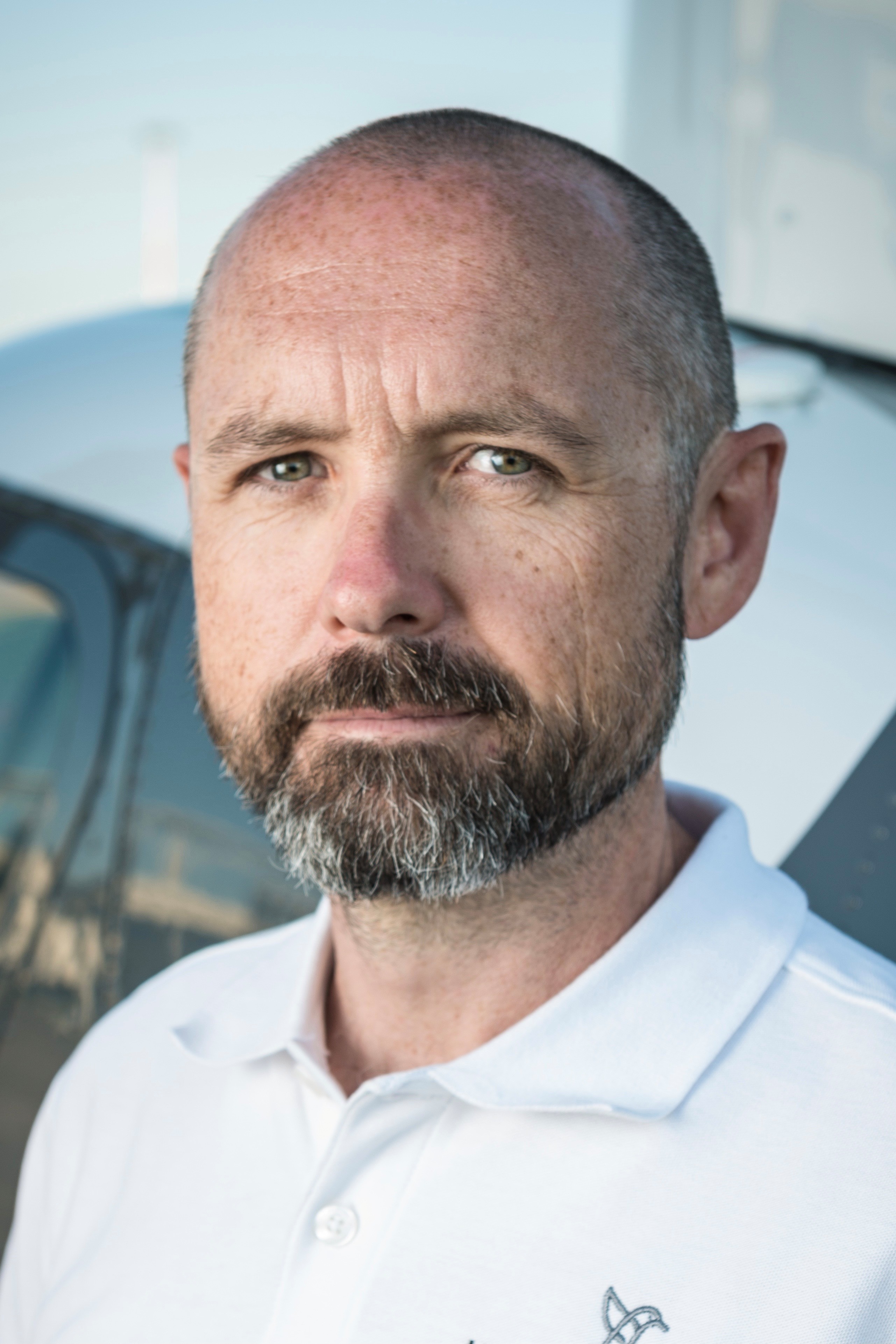
From flying air ambulance missions over Saudi Arabia to navigating the corridors of European Union national aviation authorities, Matt Rake has spent over two decades operating at the sharp end of aviation — first in the cockpit, and now in the regulatory arena. As StirlingX's Chief Regulatory Officer, Matt is the person responsible for making sure we can do what we want to do, and for quietly shaping the rules that will define the entire drone industry for years to come.
We sat down with Matt to talk helicopters, the Hajj, Amazon, and why patience might be the most important skill in the business.
From Piston Engines to Turbines: Building a Career in the Air
Q: You describe yourself as a career helicopter pilot. Where did it all start?
Matt: I'm not ex-military, so it was all self-funded — from my private pilot licence all the way through to commercial. I did a chunk of my training in the UK and then went to Florida to build hours and experience. I ended up getting a job as a flight instructor out there, teaching pilots to fly in normal (visual) conditions and under instrument conditions — simulated instrument meteorological conditions (IMC), which is a different and more complex skillset entirely. Two years of that gave me a really solid grounding in everything from meteorology to aircraft systems.
Q: What came after Florida?
Matt: I came back to the UK and carried on instructing — primarily in Northern Ireland and England — and then got a bit restless one summer and went and flew photographers along the south coast of France. Saint Tropez. Low-level, below 200 feet, chasing yachts while a photographer on board took pictures of people on their boats. Someone had rigged up a scrolling phone number and website on the side of the helicopter so people could buy the photos online. It was brilliant fun. Nice weather, nice apartment. I did a season of that and then it was back to reality.
Q: Your career then took a pretty dramatic turn with a role in Saudi Arabia. What was that?
Matt: That was my first job flying larger twin turbine aircraft under the two crew concept. I went to work for Abu Dhabi Aviation — they'd won a contract to deliver the first civilian air ambulance service in Saudi Arabia, operating for the Saudi Red Crescent. We flew Bell 412s — the Huey, and we were doing emergency medical services out of Riyadh, Jeddah and Mecca. Dealing with casualties for road traffic accidents, mostly. Saudi has one of the worst records in the world for those.
Supporting the Hajj was very interesting, this is the religious festival near Mecca. Because myself and most of the crews were not Muslim, we weren't allowed within 25 kilometres of the city, so they based us out in the desert. If there was a requirement for us to collect casualties, usually a crush or stampede — hundreds of people could get injured in those — we'd fly in, load up and evacuate to the hospital. No lingering. It was intense flying, hours of waiting interspersed with high octane bursts of activity. Additionally, because you're operating heavy aircraft at high altitude in extreme heat the air is thin, the aircraft is struggling for power, and you're constantly managing fuel and endurance. You learn a lot very fast.
Q: From the desert to the North Sea — that's quite a shift.
Matt: I spent five winters in the North Sea flying Sikorsky S92s. Completely different world — again two-crew operations, but this time in real instrument meteorological conditions most of the year, landing on floating rigs and support vessels in some lively weather. It's a fantastic bit of kit, the S92. The President's getting a new fleet of them for Marine One soon enough. Anyway, I did five years of that until the oil price dropped and they started offering voluntary redundancy. I put my hand up. Took the money and started a company.
Entrepreneurship and the Move into Drones
Q: You went from the North Sea to running your own business. How did that happen?
Matt: I bought a Robinson R22 — a small single-engine piston helicopter — and set up a training company at Doncaster Sheffield Airport with my partner, Helen. I called it Hummingbird Helicopters. The region had almost no helicopter training provision, so I got busy quickly, grew the fleet to four helicopters, brought in a team of instructors, and went from delivering private pilot licence training to commercial pilot and flight instructor courses. It was seven days a week, tense and tiring, but great fun.
Q: And that's where drones came in?
Matt: I'd heard that drone pilot training was starting to be formalised, so I went up to Newcastle and did a course myself — just to understand it. I realised almost immediately that it was all based on crewed aviation training principles, which was exactly what we'd been doing for years. So, I wrote an exposition, submitted it to the CAA, explained why we were qualified to do it, and they came and audited us and said yes. We became a National Qualified Entity — an NQE — which meant we could train and assess drone pilots on behalf of the CAA. We rebranded to Hummingbird Helicopters and Drones and spun up a separate UAV entity.
Q: Then Amazon got in touch?
Matt: Out of nowhere, really. I think it started with a LinkedIn message. By that point I'd done about five years running the company and I was ready for something different, so when they said "come and run our UK flight ops team," I said yes. We sold the company and I began working from Cambridge for Amazon Prime Air. The whole Amazon Air Prime concept is packages delivered by drone within 30 minutes or less.
Amazon, and the Regulatory Frontline
Q: What did your time at Amazon teach you about regulations?
Matt: Everything — and what not to do. Amazon's approach with regulators was essentially to go in loudly, make demands, and threaten to leave if they didn't get what they wanted. In my view, that is entirely the wrong approach. It might occasionally work in the short term, but it destroys relationships, good will and the trust that you need for the long game. I watched it happen, and it shaped my whole philosophy in the opposite direction.
I also learned a huge amount about how to identify the right regulatory environments. When I went back to Amazon for a second stint, my job was to find the best jurisdiction in the EU for their European operations. I met with the aviation authorities in Spain, Italy, Poland, Germany, France — sitting across the table, understanding what they could and couldn't move on, and finding the right fit. We narrowed it down to Italy and the UK. In the UK, we down-selected Teesside Airport as the site — partly because of a nearby Amazon Robotics warehouse, partly because of the genuinely progressive local leadership there who would help push things along.
Q: What does your role as Chief Regulatory Officer actually involve day to day?
Matt: There are really two sides to it. The first is compliance — making sure we have the approvals we need to operate commercially in the way we want to operate. The second, and arguably more important piece, is engagement. We're operating at the very edge of what the current regulations allow. We're pushing for BVLOS — Beyond Visual Line of
Sight operations — and for multiple simultaneous operations (MSO), where one pilot can manage several drones across different locations at once. Those regulations don't fully exist yet. So, part of my job is to help the CAA understand the technology, trust the technology, and help them shape the regulations accordingly.
Q: How do you approach that without pushing too hard?
Matt: Crawl, walk, run. That's it. You approach regulators gently, build trust incrementally, and only ask for more once you've demonstrated that you can handle what you already have. You also have to genuinely understand what they care about — and the CAA care about one thing: safety. Not commerce. Safety. Once you accept that, you stop fighting it and start working with it. You prove that your technology is safe, your procedures are robust, your emergency protocols are solid. Then they'll walk with you.
Q: What do organisations most commonly get wrong with regulators?
Matt: They go in too fast and too loud. They don't put enough thought into their safety case, and they don't put themselves in the shoes of the regulator. The CAA is not your adversary — they have a job to do. When you treat them as a partner and earn their trust, they become enormously helpful. When you treat them as an obstacle, they become exactly that.
Q: Why does all of this matter commercially?
Matt: Because we're a business. Simple as that. BVLOS and multiple simultaneous operations are the two things that will genuinely transform the economics of this sector. Right now, you need a pilot standing in a field watching every drone they fly. Remove that constraint, and you remove a huge operational cost. You can scale. You can pass savings on to customers. The sky isn't going to go dark with drones until those two things are in place — but when they are, this industry changes fundamentally.
Q: How confident are you that those regulations are coming?
Matt: Very. The UK has committed to introducing a path for Operators to conduct routine BVLOS regulations in 2027. The Americans are working on Part 108. Australia is moving fast. The EU is gradually formalising it. China is already there with routine BVLOS permissions, but western countries aren’t far behind, and we at StirlingX will be ready when it happens. StirlingX is one of only six companies in the UK authorised to conduct BVLOS operations under the CAA's sandbox trial. With regard to BVLOS, we’ve crawled and walked and will be running in May this year.
Q: What drew you into regulations specifically, rather than staying operational?
Matt: Honestly? It was organic. I never planned it. But 20-plus years of operational experience gives you a fluency with regulations that many people in this industry don't have. Amazon brought me in partly because they didn't understand the regulatory
landscape and needed someone who did. And once you're in those rooms, having those conversations, you realise the enormous leverage you can have — not just for your own company, but for the industry as a whole. I find that genuinely exciting.
Quick Hits with Matt
Lives: Sheffield.
Joined StirlingX: February 2024.
Proudest regulatory achievement: Navigating the CAA's six-stage Airspace Change Process to secure airspace for BVLOS operations.
